
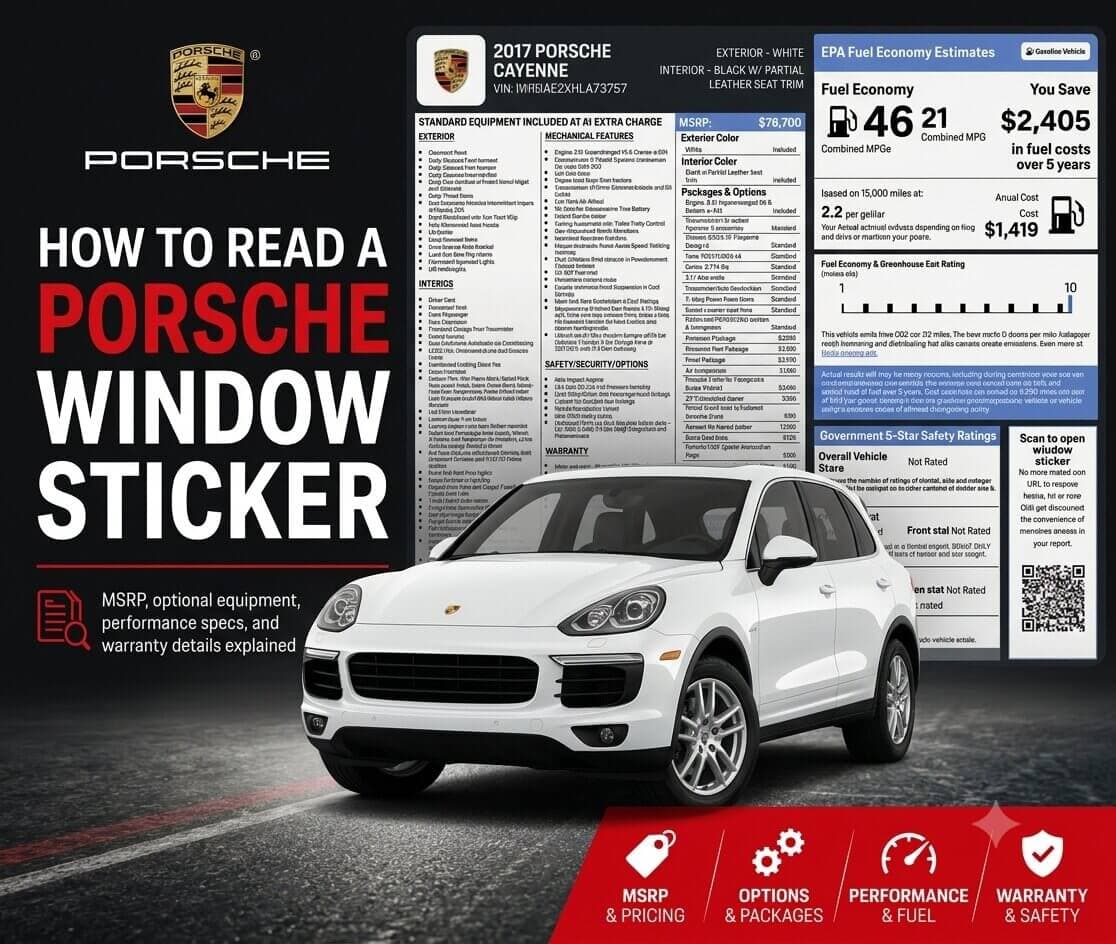
Porsche ownership is about passion, performance, and pedigree. But that passion can quickly turn to regret if you overpay for a car that's missing key factory options or has been modified in ways that hurt its value. The window sticker (officially called the Monroney Label) is your factory truth-teller. It reveals exactly how your Porsche left the factory: every option, every package, and every specification.
This guide will walk you through every section of a Porsche window sticker, explain what makes Porsche stickers unique, and show you how to use this document whether you're buying, selling, or simply documenting your dream car.
Key Takeaways:
- A Porsche window sticker shows the vehicle's original factory build, including MSRP, standard equipment, options, colors, performance specs, and warranty.
- Porsche has unique features like the under-hood option code sticker and the Certificate of Authenticity (COA) for older models.
- The sticker doesn't show accident history, title brands, or modifications—you'll need a vehicle history report for that.
What Is a Porsche Window Sticker?
A Porsche window sticker is the factory label created for every new Porsche sold in the United States. Known as a Monroney label after Senator Mike Monroney, who sponsored the Automobile Information Disclosure Act of 1958, it's required by law for all new vehicles.
Think of it as your Porsche's original birth certificate and sales sheet combined. It documents:
- Year, make, model, and VIN
- Exterior and interior colors
- Standard equipment
- Mechanical features and performance specs
- Factory options and packages with pricing
- Original MSRP and destination charge
- EPA fuel economy estimates
- Government safety ratings
- Warranty coverage
For Porsche enthusiasts, this document is particularly valuable. With dozens of possible options and packages, two Porsches with the same model name can have dramatically different values. A 911 Carrera with the Sport Chrono Package, ceramic brakes, and Exclusive Manufaktur interior is a very different car from a base model with standard equipment.
Why Reading the Sticker Matters Before You Buy
A Porsche can look incredible in photos and still be a value trap. Here's why the window sticker is essential.
1. It Verifies Factory Equipment
Sellers often claim their car is "fully loaded." The window sticker tells you what's actually factory-installed versus what a previous owner may have added later. For example, the Sport Chrono Package which includes a dashboard stopwatch, performance display, and dynamic engine mounts is a highly desirable option that significantly affects resale value.
2. It Provides Original Price Context
The MSRP on the sticker shows what the original buyer paid. A 2019 Audi Q5 with the Prestige Package, S line Sport Package, and Bang & Olufsen sound system had a total MSRP of $61,695. The same model with no options was significantly cheaper. This context helps you understand why one used Porsche commands a premium over another.
3. It Helps Catch Listing Mistakes
Dealer feeds are not perfect. Private sellers guess. The window sticker lets you compare the listing against the factory label instead of trusting the ad word-for-word.
4. It Supports Insurance and Resale
Clear documentation of factory specifications helps with insurance valuations, total loss claims, and resale negotiations.
Porsche Window Sticker Lookup: How to Find Yours
Using the VIN to Get a Replacement
The easiest way to get a Porsche window sticker is through our VIN lookup service. Here's how it works:
- Locate your VIN on the dashboard (driver's side), driver-side door jamb, front luggage compartment (frunk), or registration document.
- Enter your VIN into our window sticker lookup tool.
- Purchase and download your sticker as a PDF for viewing or printing.
Important: For U.S. VINs, the vehicle must be model year 1981 or newer. For classic Porsches with 5-14 digit VINs, look for services that specifically support older vehicles.
Check the Under-Hood Option Code Sticker
This is a unique Porsche feature. Starting in 1978 with the 911SC, Porsche began placing an option code sticker (also called the VIN tag or chassis tag) on the vehicle itself.
Where to find it:
- 911 models: Under the front trunk lid
- 928, 944 models: On the rear trunk floor
- Some models: Inside the warranty/service booklet
This sticker contains the VIN, vehicle type, engine and transmission serial numbers, and all the optional equipment codes (M-codes) as the car left the factory.
Pro Tip: The option code sticker is a quick way to verify a car's originality. If it's missing or peeled off, it could indicate a replaced hood or repaint, or it may simply be missing from the service booklet.
Certificate of Authenticity (COA) for Older Porsches
If you own a classic Porsche (pre-1981 or just want a more detailed document), you can request a Certificate of Authenticity (COA) from Porsche Cars North America (PCNA).
What you need:
- VIN number
- Proof of ownership (Vehicle Identification Card, registration, or bill of sale)
Process:
- Download the COA form from Porsche's website or call 1-800-PORSCHE.
- PCNA charges a fee (historically around $45) for the service.
Important: The COA is not the same as the original window sticker, but it covers much of the same information, including the complete list of options. It's often referred to as the "Kardex" or "Cardex".
Section-by-Section Guide to the Porsche Monroney Label
Let's decode every section of a Porsche window sticker. We'll use a hypothetical 2024 Porsche 911 Carrera as our example.
Section 1: The Header
The header appears at the top of the window sticker and contains basic identifying information about the vehicle.
Vehicle Identification Number (VIN): The 17-character VIN is displayed prominently. It's your unique vehicle identifier. Always verify that the VIN on the sticker matches the VIN on the dashboard, door jamb, and title.
Model and Trim Level: The sticker clearly states the model (e.g., 911 Carrera, Porsche Macan, Porsche Taycan) and trim level (e.g., Base, S, 4S, Turbo, Turbo S).
Model Year: The model year may differ from the calendar year of manufacture. This is normal in the automotive industry's model year cycle.
Exterior and Interior Colors: Color details are more useful than they look. The sticker shows factory color codes for paint and upholstery, which is essential for confirming originality or planning a restoration.
Section 2: Standard Equipment
This section lists all equipment that comes included with the base trim level—before any optional packages are added.
Core Comfort and Convenience Features: This may include Porsche Communication Management (PCM), leather seating surfaces, climate control, and power-adjustable seats.
Safety Basics: Standard safety features such as airbags, stability control, and rearview cameras are listed here.
Exterior Features: LED headlights, heated mirrors, and a power tailgate may be listed as standard on certain models.
Section 3: Optional Equipment
This is one of the most important sections. It lists every package and individual option added to the vehicle, along with their costs.
Factory Option Packages
Individual Add-On Options:
- Bang & Olufsen / Burmester Sound System: Premium audio upgrade
- Porsche Ceramic Composite Brake (PCCB): High-performance brakes with yellow calipers
- Adaptive Air Suspension: Electronically controlled ride height and damping
- Sport Exhaust System: Enhanced sound with valve control
- Special Paint Colors: Custom finishes like Paint to Sample (PTS)
Port-Installed Accessories: Items added at the port of entry before the vehicle reaches the dealership, such as all-weather floor mats, carbon fiber mirror caps, and roof rack crossbars.
Why This Section Matters:
- Verification: Confirms exactly which options were factory-installed.
- Value Assessment: Determines if the vehicle has high-value options that justify a higher price.
- Negotiation Leverage: Provides documentation if the seller claims options that aren't present.
Section 4: Mechanical and Performance Specifications
This section explains the powertrain and chassis details, which are crucial for any Porsche enthusiast.
Engine Specifications:
- Displacement (e.g., 3.0L twin-turbo flat-six)
- Horsepower (e.g., 443 hp)
- Torque (e.g., 390 lb-ft)
- Fuel type (premium gasoline, hybrid, electric)
Transmission:
- Type (e.g., 8-speed dual-clutch PDK, 7-speed manual)
- Drive type (Rear-wheel drive, all-wheel drive)
Drivetrain Layout:
- Rear-engine, all-wheel drive for the 911 Carrera 4S
- Mid-engine, rear-wheel drive for the 718 Cayman
Power and Performance Figures:
- Power output (hp / kW)
- Torque and performance figures
- Acceleration and top speed
Section 5: Fuel Economy and Emissions
This section displays the official EPA fuel economy ratings for the specific vehicle configuration.
EPA Estimates:
- City MPG
- Highway MPG
- Combined MPG
- Annual fuel cost estimate
For Hybrid and Electric Models (e.g., Panamera E-Hybrid, Taycan):
- MPGe (miles per gallon equivalent)
- Electric range
- Charging time
Important Notes:
- EPA estimates are for comparison purposes. Actual mileage depends on driving habits, conditions, and vehicle maintenance.
- Quattro AWD models typically have slightly lower fuel economy than rear-wheel-drive versions.
Section 6: Safety Ratings
This section displays crash test ratings and safety equipment information.
NHTSA Ratings:
- Overall vehicle score (1 to 5 stars)
- Frontal crash rating (driver and passenger)
- Side crash rating (front and rear)
- Rollover rating
Safety Features List:
- Airbags (number and location)
- Stability control (ESC)
- Crash avoidance systems (automatic emergency braking, lane-keeping assist, night vision)
Section 7: MSRP Calculation
This section shows the price breakdown that adds up to the total Manufacturer's Suggested Retail Price.
Why This Section Matters:
- Original Value: Shows exactly what the vehicle cost when new
- Depreciation Baseline: Used to calculate how much value the vehicle has lost
- Insurance Valuation: Reference for agreed-value policies and total loss claims
- Resale Documentation: Demonstrates original configuration and value to potential buyers
Section 8: Warranty Information
Warranty details show the original factory coverage when the Porsche was new.
Important Notes:
- Factory warranties typically transfer to subsequent owners (unlike some extended warranties).
- Regular maintenance is required to maintain warranty coverage.
What a Porsche Sticker Does NOT Tell You
A window sticker tells you the factory story. It does not tell you the used-car story.
It usually does not show:
- Accident history
- Title brands (salvage, rebuilt, flood)
- Odometer problems
- Ownership changes
- Theft records
- Lien or loan records
- Auction history
- Aftermarket modifications
Crucial for Porsches: If you're buying a used Porsche, compare the window sticker with a vehicle history report. The sticker shows how the Porsche started. The history report helps show what may have happened later.
Frequently Asked Questions About Porsche Window Sticker
How do I get a Porsche window sticker without a VIN?
You can retrieve a Porsche window sticker by entering the license plate or Year-Make-Model (YMM) through our window sticker lookup tools
Why are Porsche window stickers important?
They verify the vehicle's original factory equipment, MSRP, options, and specifications, which is essential for buyers, sellers, collectors, and insurance purposes.
What is the difference between a window sticker and a Certificate of Authenticity?
A window sticker is the original Monroney label showing pricing and options for the U.S. market. A COA is an official verification document from Porsche, often used for classic cars.
How can I read a Porsche VIN?
Use a Porsche VIN decoder to verify original specifications, engine, transmission, features, and optionally, upgrade to a vehicle history report to see the vehicle's past, such as accidents and ownership history.